


.webp)
Measuring the Intelligence Layer: Buoyant's 2025 Impact Report
Five years ago we started publishing an annual impact report because we wanted to hold ourselves to the same standard we ask of our founders: lead with intention and say what you are going to measure, then show the number. Our 2025 Impact Report, out now, is the fifth edition and it lands at a moment when the question of whether climate outcomes and durable businesses can coexist has stopped being theoretical.
Over the last several years, climate tech has gone from consensus to a market defined by scrutiny and execution. Capital became more selective. Policy support became less predictable. Categories that once attracted abundant funding are now facing harder questions about timelines, unit economics, and deployment risk.
What emerged in place of that consensus is a healthier distinction between technologies that are merely promising and products customers urgently need. That distinction increasingly favors AI, software, and simple hardware - things that can be bought this quarter, deployed against an existing operational problem, and measured. Our founders spent 2025 building through that environment, and they did it by focusing not on growth at any cost, but on products customers adopt because they solve something real.
Three buildouts, one supercycle
The backdrop for the next decade is not scarcity of capital for physical infrastructure. It is the opposite. Three simultaneous buildouts are converging into a single supercycle, and all three depend on software to function at scale.
AI infrastructure. The five largest hyperscalers are executing what may be the most aggressive coordinated capex cycle in modern history — expected to reach nearly $690 billion in 2026 alone and $4.7 trillion between 2025 and 2030, with roughly 100 GW of new capacity anticipated to come online by 2030. That creates sustained, structural demand for software that makes compute more efficient. It is not a cyclical bet.
Energy and utilities. The grid has to absorb all of that new load while simultaneously modernizing aging infrastructure and integrating new generation. Aggregate energy utility spending for the 2026–2030 period is forecast at a record $1.3 trillion, the highest five-year forecast on record. The capital is being committed. The software to operate those systems intelligently is still being built.
Industrial reshoring. Companies announced $1.42 trillion in planned U.S. manufacturing investment between January 2025 and mid-March 2026, led by semiconductors, pharmaceuticals, and other strategically important industries. These facilities are energy-intensive, data-rich, and largely running on legacy operational software.
Physical capital at this scale does not, by itself, make systems efficient, resilient, or decarbonized. The intelligence layer — the software and AI that optimizes how these systems run — is where value is created and compounded. A 10% improvement in how infrastructure is built and operated represents trillions of dollars in value while reducing costs, emissions, and resource use at the same time. That is the arithmetic our thesis rests on.
2025 Impact Compounds
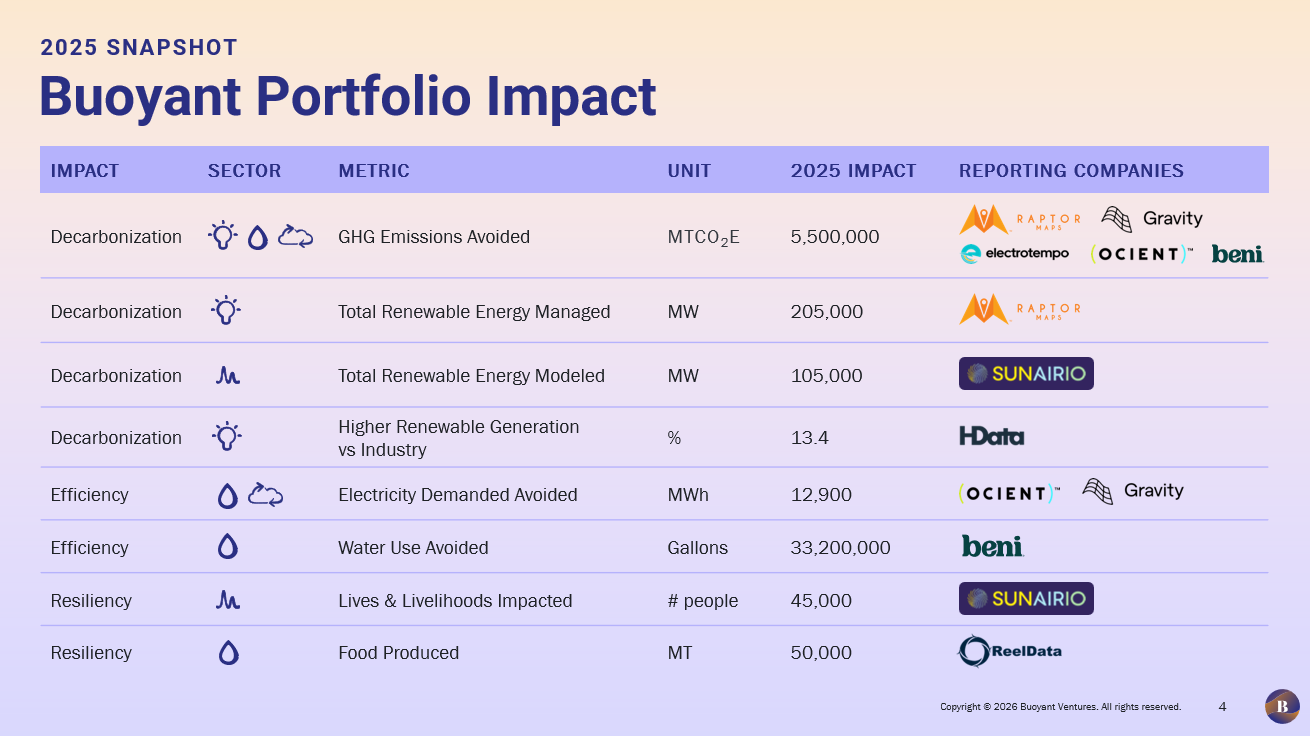
Our portfolio spans four categories (energy, industrials, efficient computing, and climate intelligence) and three impact themes (decarbonization, efficiency, and resiliency). Each company reports unique metrics tied to their underlying operational metrics, because as they scale, so does their impact. At the highest level, our companies reported the following impact in 2025:
Where AI creates value rather than erasing it
The obvious question for any software investor right now is whether large language models commoditize the thing you just funded. Our answer, borne out across the portfolio in 2025, is that LLMs have commoditized software development and in doing so shifted competitive advantage away from code and toward three things that are much harder to copy. These are proprietary data and domain expertise and enterprise trust.
Proprietary data and domain expertise: Our companies sit on data a public model cannot generate, such as metered grid telemetry, sensor histories, permitting records, verified emissions, field measurements. The code is not the moat; it’s the data asset captured and the domain logic that are differentiated. The data asset can be captured from a low costs sensor or camera (i.e., ReelData, RaptorMaps, etc) while the domain logic is how the data is structured and accessed (i.e. HData, Gravity, etc). Deep domain expertise is also crucial. The founders industry knowledge embedded into workflows cannot be replicated by a generic model with a wrapper.
Enterprise trust: Utilities, industrials, and financial institutions buy on SOC 2, SSO, audit trails, data residency, uptime guarantees, and regulatory validation, alongside the integrations and support model that mission-critical operations require. A generated prototype clears none of those bars.
What we are watching next
Four themes are shaping where we look for our next investments.
In energy, the grid is the bottleneck to AI growth, and the collision between aging infrastructure and data center demand is landing on ratepayers.. Utilities can no longer defer software solutions to improve asset utilization that can drive down rates and improve reliability.
In efficient computing, the shift from training to inference has permanently changed the energy equation; agentic architectures mean a single user interaction can trigger dozens of background inference calls, a recursive energy multiplier that software optimization can address.
In industrials, energy has become a determinant of competitiveness rather than a line item, while thinning technical workforces mean fewer people are available to catch inefficiency manually. At the same time, AI is making more automation a reality.
And in climate intelligence, the value is shifting from data to decisions: wildfires, floods, and extreme heat are repricing assets faster than legacy models can update. Every part of the world is affected with different forms of risk, with July being the hottest month globally on record.
Five years in
Our belief has not changed: climate outcomes and strong businesses are not in conflict. The most enduring climate companies will likely be the ones that help the world's largest industries operate more intelligently, efficiently, and resiliently. As a 100% woman-owned firm, we also continue to believe diverse teams build stronger companies – 71% of our portfolio companies have at least one underrepresented founder.
We are proud to support founders building exactly those kinds of businesses, and deeply grateful to the LPs, founders, customers, and partners who keep building alongside us.
Read the full 2025 Impact Report for company-by-company metrics, company spotlights on Gravity and Sunairio, portfolio demographics, and our complete measurement methodology. Request a copy of our 2025 impact report here.
Related Posts
Subscribe to stay updated on news, insights, & invites to special events within our community.
We’re lighting the path forward for the ClimateTech industry—keep up with us along the journey.

