


.webp)
Investing in the Intelligence Layer for the Physical World
How market forces, portfolio lessons, and a $100+ trillion infrastructure buildout shapes our strategy
When we launched Buoyant Ventures Fund I in 2020, we set out to back software entrepreneurs that were working to make the world more efficient, decarbonized and resilient. Six years, 17 investments, and countless founder conversations later, that mission hasn't changed. However, in that same period, the world has changed dramatically, and so has how we think about the opportunity. We wanted to share why.
The World Changed. We Responded.
We began investing during a moment of climate tech optimism. Since then, the ground shifted in ways that required us to evolve our thinking, not abandon it.
Political Environment: Climate regulations weakened so we doubled down on core business value resilient to political cycles. We prioritized solutions that deliver ROI regardless of policy support, ensuring durability across administrations.
Technology Catalyst: Generative AI made a step-function leap forward, forcing us to evaluate every investment for both AI disruption risk and AI-enabled opportunity. We doubled down on durable, defensible technologies and teams that can adapt as the technological frontier rapidly evolves.
Geopolitical Turmoil: Supply chain disruptions and energy security concerns elevated resilience from a "nice to have" to an economic priority. We favored companies that build resilience into critical systems while also positioning themselves to compete and sell across global markets.
Capital Markets: Interest rates rose so capital efficiency became paramount over growth-at-all-costs. We leaned into teams that can scale with discipline, strong unit economics, and shorter paths to profitability.
Infrastructure Crisis: Load growth driven by demand for AI has led to an infrastructure buildout like we have not seen in decades. As a result, grid connection queues and equipment orders have been backlogged,so software unlocking existing capacity became imminently valuable. This dynamic reinforced our focus on solutions that increase throughput without requiring new physical build.
The bottom line? Fund I began investing during climate tech optimism. We are now investing in a market shaped by infrastructure necessity and climate realism.
The $100 Trillion Opportunity
By 2040, $100+ trillion will be invested in energy, grid, data center, and industrial infrastructure—driven by AI acceleration, decarbonization mandates, and the growing need for resilience.
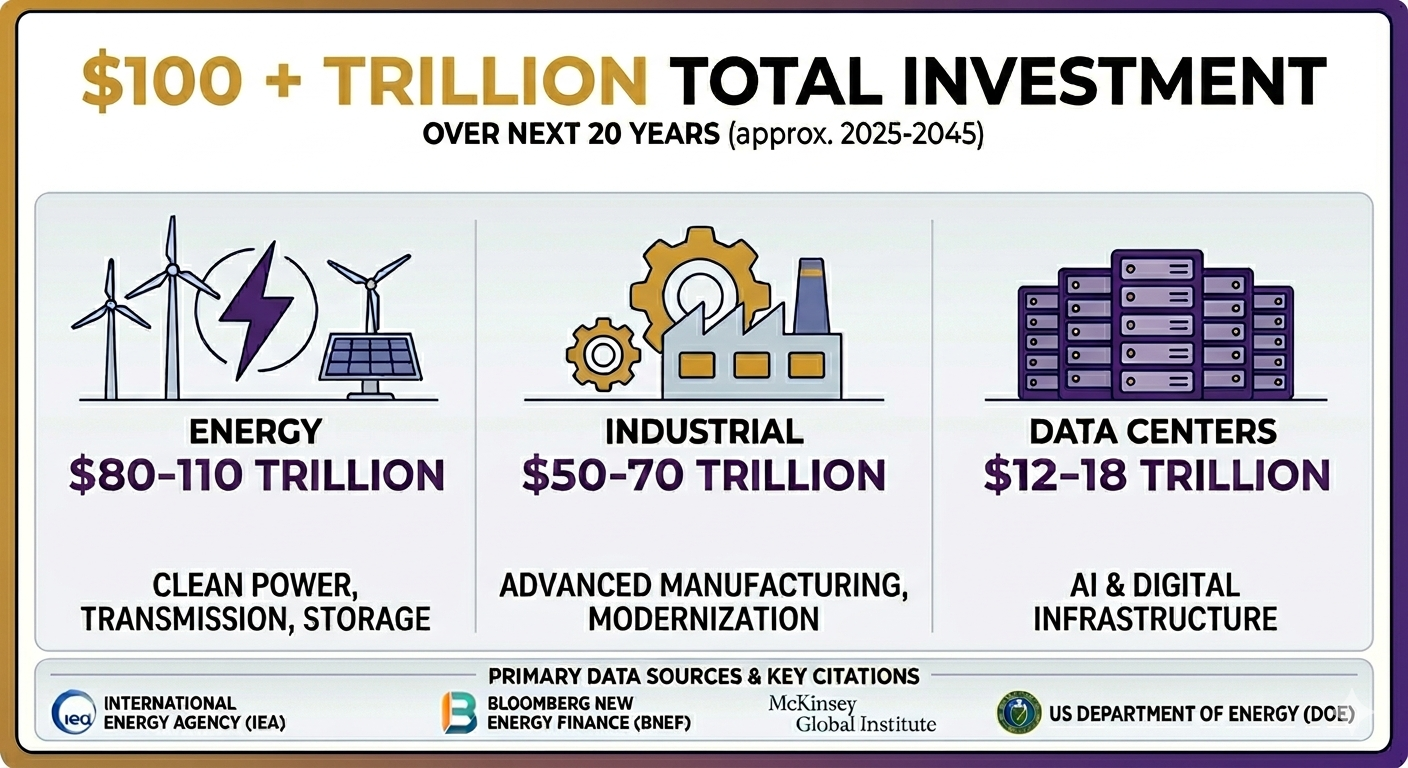
We believe the greatest opportunity lies in the intelligence layer: software and AI that optimize, decarbonize, and unlock capacity across this massive physical buildout while strengthening system resilience. As infrastructure scales, intelligence will determine performance.
Even a 10% improvement in efficiency represents over $10 trillion in value creation. This is the market we are targeting and where we see the next generation of enduring, category-defining companies being built.
Four Categories, One Insight
Our investment focus has narrowed into four interconnected industry segments:
Energy – Grid-enhancing technologies, interconnection solutions, and software that enables flexibility across increasingly constrained power systems. As load growth accelerates, particularly from AI, the grid—not generation—has become the bottleneck. We focus on technologies that unlock capacity, accelerate interconnection, and improve reliability without requiring equivalent physical expansion.
Efficient Computing – Software and AI infrastructure stack innovations that enable doing more with less—reducing compute costs, energy consumption, and hardware intensity. As AI scales, efficiency is becoming as important as capability. We back companies rethinking the architecture of compute to drive step-function improvements in performance per watt and per dollar.
Industrials – Digital technologies driving efficiency across manufacturing and heavy industry. These sectors represent a massive share of global GDP yet remain under-digitized and operationally complex. We prioritize solutions that improve throughput, reduce waste, and enhance resilience across critical industrial systems.
Climate Intelligence – Tools delivering ROI through climate risk reduction and resilience planning. As climate volatility increases, resilience is shifting from a compliance exercise to a core business function. We invest in platforms that quantify risk, inform decision-making, and help enterprises adapt to an increasingly uncertain environment.
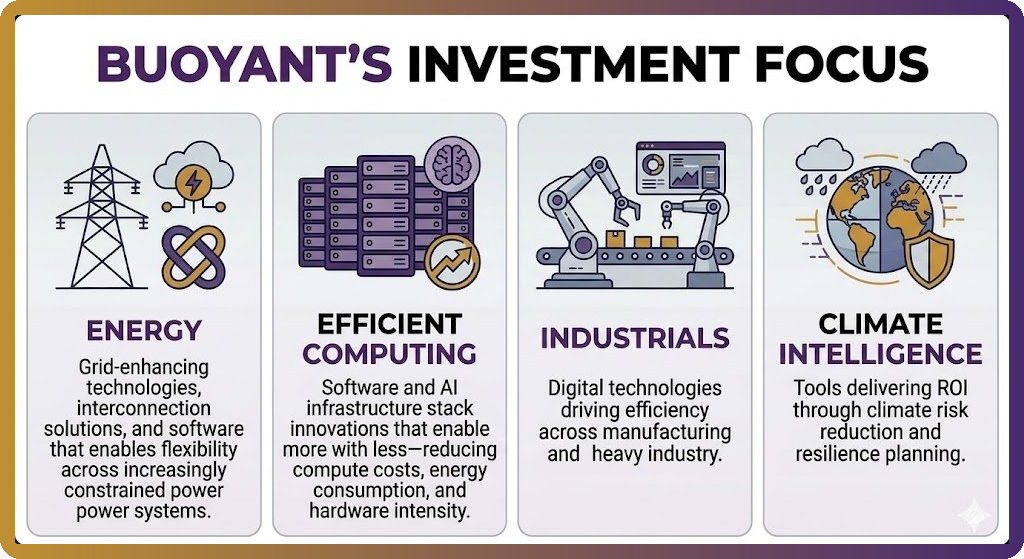
The unifying insight? AI growth and infrastructure constraints create an efficiency imperative. Whether AI scales explosively or moderates, enterprises need software that makes infrastructure work harder, last longer, and cost less.
Our Thesis Doesn't Depend on AI
Can the explosive growth in AI continue? Not likely at the current pace. We expect a slow down starting in 2027 when the difficult realities of building out the data center and energy infrastructure start to show cracks. However, load growth is not just driven by AI.
Here's our contrarian take: our thesis strengthens if AI growth slows. The underlying problems exist regardless:
- Grid modernization: utility interconnection queues long predate the AI boom
- Climate risk reduction - rising insurance losses and climate volatility continue independent of AI adoption
- Industrial efficiency - structural cost pressures in manufacturing and heavy industry are persistent
- Data center utilization - demand for compute and storage extends well beyond AI-specific workloads
AI growth creates urgency and expands opportunity. But a slowdown would reinforce the importance of what we focus on: delivering measurable operational ROI, not speculative capability.
What We Look For
If you're building software and AI that optimizes physical infrastructure, here's what excites us:
Irreplaceable Data Assets – Access to novel data through sensors or cameras, or exclusive partnerships, creating proprietary datasets
Deep System Integration – Embedded in mission-critical workflows with compounding switching costs
Domain Expertise – Founders who understand both software and industry operational realities and whose expertise is embedded into the product technology and delivery. These solutions will be difficult for horizontal models to replace.
AI-Native Architecture – Built for the AI era, not retrofitted with AI features
Capital Efficiency – Clear path to profitability without requiring hundreds of millions in capital deployment
Demonstrated Grit – Track record of navigating setbacks successfully
The Opportunity Ahead
We're living through the largest infrastructure transformation in human history. The convergence of AI acceleration, decarbonization mandates, grid modernization, and geopolitical reshoring is creating unprecedented software opportunities.
What makes this moment different from previous infrastructure cycles? Software scales instantly while physical infrastructure takes decades. Companies solving today's bottlenecks with intelligent software will capture outsize value as the physical buildout continues.
We are clear-eyed about a turbulent macro backdrop. Geopolitical instability and its effects on energy prices and inflation are creating real headwinds across markets. But periods of disruption consistently reward disciplined investors with conviction — and we see significant opportunity at the intersection of AI, energy, computing, industrials, and climate intelligence.
Connect With Us
For Entrepreneurs: If you're building software that optimizes energy, computing, infrastructure, or industrial operations, we want to hear from you: team@buoyant.vc.
For Everyone: Follow our research and insights at buoyant.vc or connect with us on LinkedIn and subscribe to our Lighthouse Newsletter.
Related Posts
Subscribe to stay updated on news, insights, & invites to special events within our community.
We’re lighting the path forward for the ClimateTech industry—keep up with us along the journey.

